
The relationship between Element and Matrix.
Element is led by the same team that created the Matrix open standard.

The Matrix open source project began in 2014, with the goal of creating the missing communications layer of the open web; a decentralised open standard for real time communications.

In 2017 the same founding team created Element, with the intention of demonstrating what could be created on top of Matrix. As a for-profit firm, the creation of Element also provided a way to attract venture capital investment to build out both Matrix and Element itself.
Element - commitment to Matrix development.
Element is the primary upstream vendor for Matrix, and has contributed more than 90% of key server components and SDKs to the project. Element continues to develop and maintain that vast majority of the Matrix open standard. All of this work is contributed to the Matrix project without cost.
Element’s revenue.
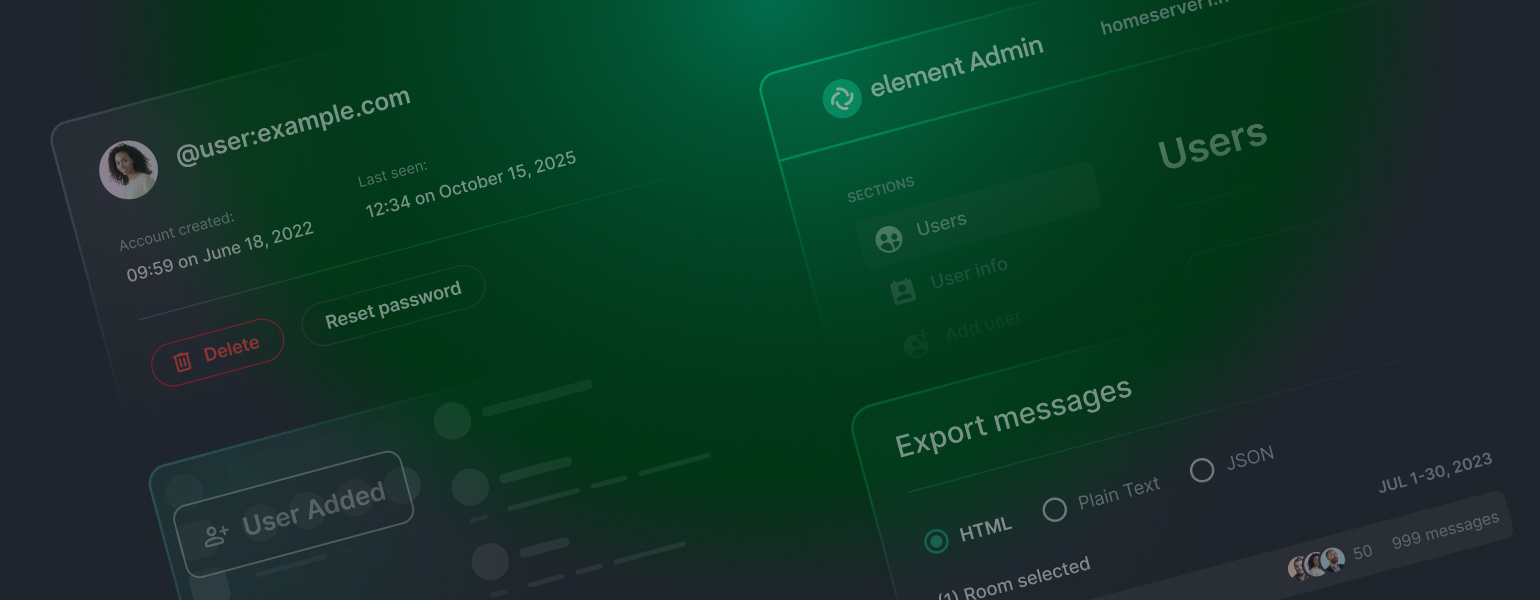
Element’s business model is to derive profitable revenue from selling subscriptions to an enterprise-grade server-side solution (
Element Server Suite Pro
) for governments and other large public sector organisations. It provides a mature backend solution, complete with required enterprise-grade features such as advanced identity and access management, record keeping and administrative functions for corporate control and oversight. It also includes advanced security advisories, technical support and services.
The principle is that Element provides - as a core competency - a robust, powerful server-side solution that gives a government all it needs to run a digitally sovereign Matrix-based deployment. It saves multiple governments re-inventing the wheel, and enables any bespoke open source development to focus on use case specific requirements. Provided governments subscribe to Element Server Suite Pro, it also ensures that the Matrix open standard has a well-resourced upstream vendor that can continue to invest in Matrix development and maintenance.
Element is committed to open source software, and the Matrix open standard its leaders created, because of a core belief in software transparency, the importance of interoperability and the right for end-users to have digital sovereignty. None of this is possible if Element makes all of its software development available free of charge. There has to be a revenue stream to pay developers’ salaries.
The principle is that Element provides - as a core competency - a robust, powerful server-side solution that gives a government all it needs to run a digitally sovereign Matrix-based deployment. It saves multiple governments re-inventing the wheel, and enables any bespoke open source development to focus on use case specific requirements. Provided governments subscribe to Element Server Suite Pro, it also ensures that the Matrix open standard has a well-resourced upstream vendor that can continue to invest in Matrix development and maintenance.
Element is committed to open source software, and the Matrix open standard its leaders created, because of a core belief in software transparency, the importance of interoperability and the right for end-users to have digital sovereignty. None of this is possible if Element makes all of its software development available free of charge. There has to be a revenue stream to pay developers’ salaries.
Element’s commitment to open source and the FOSS community.
The vast majority of Element’s development is made available as open source software under an AGPL v3 license. Element’s intention is to provide individuals and the FOSS community with performant, reliable software for non-professional use that is available free of charge.
Enterprise-grade features developed by Element are proprietary to generate revenue through the sale of subscriptions to government and other large public sector organisations, who routinely pay proprietary vendors for software solutions.
Enterprise-grade features developed by Element are proprietary to generate revenue through the sale of subscriptions to government and other large public sector organisations, who routinely pay proprietary vendors for software solutions.

The Matrix Foundation.
A non-profit community interest company, The Matrix.org Foundation's role is to safeguard the Matrix open standard, primarily as a result of independently managing the Matrix specification and publicising Matrix. It operates in accordance with its
manifesto
.
The Matrix Foundation has four legal directors, two of whom are from the original founding team and still at Element. It also has an advisory Governing Board that is made up of elected representatives from all across the Matrix ecosystem. Members of the Spec Core Team , who donate their time and work without cost, are employed by a range of organisations including Beeper, Element, Red Hat, Simplisafe and The Matrix Foundation.
Element manages and maintains the matrix.org homesever on behalf of The Matrix Foundation. Third party cost (primarily server space) is passed to The Matrix Foundation; employee time is donated by Element.
The Matrix Foundation has four legal directors, two of whom are from the original founding team and still at Element. It also has an advisory Governing Board that is made up of elected representatives from all across the Matrix ecosystem. Members of the Spec Core Team , who donate their time and work without cost, are employed by a range of organisations including Beeper, Element, Red Hat, Simplisafe and The Matrix Foundation.
Element manages and maintains the matrix.org homesever on behalf of The Matrix Foundation. Third party cost (primarily server space) is passed to The Matrix Foundation; employee time is donated by Element.
Supporting Matrix.
The Matrix open standard is of critical importance for anyone that believes in digital sovereignty and the interoperability of real time communications.
Element is now one of many for-profit vendors in the Matrix ecosystem. Element is confident of its position within that marketplace based on its product excellence, outstanding value and unrivalled Matrix expertise. Whether a government or large public sector organisation chooses to work with Element or not is dependent on Element’s ability to communicate its value and the free marketplace choice the end-user organisation makes.
What Element asks is that any government or large public sector organisation choosing a partner for a Matrix-based deployment ensures that partner is actually contributing to the overall health and future of the Matrix open standard. Not in terms of contributions (which puts unfunded pressure on The Matrix Foundation), but in terms of direct monetary investment in The Matrix Foundation. This is a question that purely in-house projects should ask themselves too.
A starting point should be seeing if the chosen supplier is a paying member of The Matrix Foundation, or an end-user organisation becoming a member itself.
Element is now one of many for-profit vendors in the Matrix ecosystem. Element is confident of its position within that marketplace based on its product excellence, outstanding value and unrivalled Matrix expertise. Whether a government or large public sector organisation chooses to work with Element or not is dependent on Element’s ability to communicate its value and the free marketplace choice the end-user organisation makes.
What Element asks is that any government or large public sector organisation choosing a partner for a Matrix-based deployment ensures that partner is actually contributing to the overall health and future of the Matrix open standard. Not in terms of contributions (which puts unfunded pressure on The Matrix Foundation), but in terms of direct monetary investment in The Matrix Foundation. This is a question that purely in-house projects should ask themselves too.
A starting point should be seeing if the chosen supplier is a paying member of The Matrix Foundation, or an end-user organisation becoming a member itself.


.png)